The main cutaneous folds on the human body
You can only see a small portion of your cutaneous folds. However, you can feel them all with your nails.
Fold types
The folds in the skin of your body can be classified into several types, determined by their angle, origin and location.
Horizontal folds
Horizontal folds are the most common and obvious type of fold.
We all have visible horizontal folds on our forehead, neck, elbows, wrists, fingers, knees, ..., yet most of them are hard to see.
Horizontal folds keep on developing all your life.

Most horizontal folds are formed in places where the skin covers an articulation.
Horizontal fold formation
As soon as the fetus starts moving, around the sixth week, its actions create horizontal folds in the skin.
Even if this horizontal folding starts very early; the initial vertical folds are already in place.

At birth, some horizontal folds are already so etched-in that they've become permanent.

Permanent folds compress the skin, and reduce the action of the muscles, blood vessels, and nerves that pass beneath them.
This baby's wrist is tiny, but it's already strangled.
As the body grows and the wrist enlarges, the constricting effect increases.
Horizontal folds deepen and multiply as a person ages.

For more information on children and cutaneous folds
Horizontal folds and articulations
Most horizontal folds occur in places where the body can be flexed.

However, horizontal folds can also be found between articulations, and along stretches of skin that cover bones where no bending or flexing occurs.
These folds may be smaller and shallower than those at articulations, they still can be the source of pain, or aesthetic problems.
Compressed and stretched horizontal folds
The articulations on your body can only be flexed on one side.
Because of this, different kinds of folds are created on each side.
The skin that surrounds an articulation resembles a bent pipe.
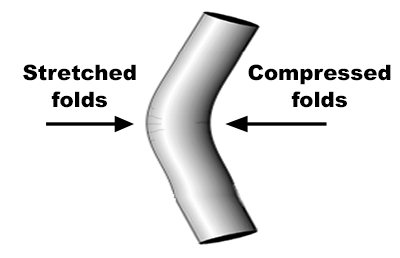
Stretched folds
On the stretched side of the articulation, flexing inward causes the skin to expand and stretch, to cover a larger area.

But, when the articulation returns to its straight position, the folds in the skin create the draping effect we are familiar with.

You bend your joints so often, that permanent folds have formed.
Besides the aesthetic problems that the dangling skin can cause, stretched folds can be painful.
They are the source of arthritis.
If you close the articulation inward, the folds prevent the skin from expanding all the way, and pain is felt.
Compressed folds
On the compressed side of the articulation, bending the joint crushes the skin.
This creates deep and tight folds, where the skin is hardened.

Compressed horizontal folds pull the skin inside the articulation, more and more each day.
This prevents the articulation from closing completely, but it can cause pain every time the articulation is used.
Horizontal folds, articulations, and pain
Articulations are complex mechanisms, made of bone and cartilage, that can be flexed thousands of times every day.
The fragile skin that surrounds them is badly battered by their moving parts.
Horizontal folds are formed at every articulation, and they keep on growing larger and deeper.
They squeeze the joint more and more every time it is activated.
At some point, the skin becomes so deeply embedded in the joint that it gets pinched and crushed by the hard parts of the articulation.
You end up with pain every time you move the joint.
Knee X-ray - Wikipedia

Initially, pain may only appear when the joint is fully extended or contracted, or when it is overused.
People will respond by reducing the amplitude and force of their movements, to avoid the pain.
Over time, every joint of the body becomes completely strangled by folds, making every action difficult and painful.
This pain explains why many elderly people can hardly move anymore.
Vertical folds
The main vertical folds that run from top to bottom of your body are different from your other folds.
Vertical folds are special because they originate from the formation of your embryo, in the first weeks of your life.
They are so fundamental that they pass unnoticed, and people don't consider them as folds.
In this illustration, vertical folds are shown as being equal. In reality, those placed on simple fractions of the body (½, ¼, ...) are much deeper.

Vertical folds divide your body into halves, quarters, eighths, ....
They can be very long.
Some of them run from head to toe on one side and do the same on the other.
They circle your body, but vertically.

Notice the two huge fold crossings, (the craters in the center of this image), where the vertical folds meet the tip of the shoulder blade.
The skin has attached itself to the shoulder blade, and any movement you make pulls on the surrounding folds, often causing pain that can contribute to your backaches, headaches, or shoulder pain.
The most important fold
The vertical center fold
The vertical center fold is the largest and most fundamental fold on your body.
It runs down the middle of your body, from your head to your buttocks.
It divides you into two symmetrical halves, creating a right and a left side of you.
Many features and organs located on one side of the center fold are mirrored on the other side, but inverted.
When you observe its path, you'll notice that your body is composed of two distinct parts that are joined along this line.
Press your nails anywhere along this line, and you will feel the fold.

The central vertical fold is responsible for all kinds of particularities and deformations along its path.
Your navel, your larynx, your mouth, your nose, your hair whorl, your spine, your anus, your buttock crease, your urethra, and your sexual organs are all in its path.
On your back, it follows your spine, but the skin is completely entangled into it.
The vertical center fold is obvious and easily visible in many places on the body, yet, despite its importance, this physical feature is completely overlooked.

Observe how attached to the bone your skin has become along the vertical center fold's path.
If you run your nails along it, you'll feel that the skin is hard and deeply folded inward.
This external division of your body is also found internally in certain organs, such as your brain.

Initial vertical folds have a fetal origin
Initial vertical folds appear to originate from the early stages of fetal development.
This phenomenon could be a result of the cell division process.
Three-week-old embryos are clearly divided into two halves.

Your skin is like a banana peel or a molded object
While the other folds on your body are caused by repetitive movements and positions, initial vertical folds fundamentally divide the body into distinct sections.
These folds remind me of the seams we see on a banana peel, on pods, nuts, seeds, ...
Their surface is not really round, it has ridges, seams.

Why is it segmented?

We also observe analogous lines on molded objects made out of chocolate or plastic indicating that two or more parts have been assembled.

Your body has an internal squareness that is hidden by its general roundness.
Initial vertical folds are placed at precise angles of your body, ½, ¼, ...
Other important vertical folds
The vertical front/back fold
It separates your front, from your back.
Just like the central vertical fold, it divides your body into two halves, but this time along the side axis.
It is the longest fold of all.
Picture it as a line splitting your body into two parts as if you were viewed from the side.

It runs up and down the sides of your arms and legs, going into the detail of the side of every finger or toe.

If you're six feet tall, your vertical side center fold is over sixteen feet long.
The vertical quarter folds
They split you into quarters by re-subdividing each side created by the vertical center fold.
Even if these folds aren't as deep as the center fold, they generate pain and aesthetic problems when large horizontal folds cross them.

Their path passes straight in the middle of your eyes, breasts, knees and feet.
Diagonal folds
Diagonal folds cross the skin at an angle; rather than straight up and down or sideways.
On your body, you'll find far fewer diagonal folds than vertical or horizontal ones.
While vertical and horizontal folds are long and circular (they go completely around the body), diagonal folds are short and not circular.
They make the junction between deep fold crossing points in the vertical/horizontal grid of folds.
We can distinguish:
• Off-axis articulation diagonal folds,
• Folds that follow angled bones or muscles,
• Repetitive movement diagonal folds.
Off-axis articulation diagonal folds
Most articulations on your body are on-axis (they cross the body straight vertically or horizontally).
But, the articulations that move your shoulders and hips, along with the ones you use to close your hands or feet, are angled (off-axis).

Since these off-axis articulations are used so frequently, deep folds are formed weeks before birth, and keep on developing all through your life.

When you close your hand, you bring your fingers towards your thumb at an angle; this creates diagonal folds.

Folds that follow the bones or muscles
Your skin molds and attaches itself to whatever lies beneath it.
When it covers angled bones or muscles, diagonal folds are formed that follow them.
Your skin does this to protect itself.
By firmly attaching itself to the bone, the muscle or whatever, it limits all skin movement in the area.

To successfully anchor itself to the bone, muscle, tendon, ..., beneath it, your skin needs protrusions or uneven surfaces.
It folds and refolds over every edge or ridge until it secures itself.
Your skin anchors itself to every detail of your neck, knees, hands, feet, ..., .

When muscles are located beneath the skin tissue, it readily attaches to them.
Humans are convinced that they have muscle pain; but muscles cannot produce the kind of acute pain they feel.
In fact, the pain comes from the folded skin that has gripped the muscles.
Even muscle cramps or muscle spasms are caused by fold crossings; not the muscles.

People think that their pain comes from the muscles; when folds like this one are the culprits.
Diagonal folds from repetitive angled movements
Many people make repetitive gestures while they work.
Some movements can be done and redone thousands of times a day.
The skin folds created by these actions will grow, become permanent and, at some point, generate some pain.
But if the movements involved are off-axis, diagonal folds will form, and the pain can be much worse.

Facial expression folds
The facial nerve, one of twelve cranial nerves, is in charge of facial expressions and taste.
Facial muscles are under its control, and convey your emotional state.
This is the most natural and effective method of communication for humans.

The skin is profoundly folded by facial expressions.
The intensity of the feelings they express is conveyed by the depth of each fold.
Since these expressions are used regularly, and sometimes held for long periods, the skin would be damaged if it didn't protect itself.
It coats the bottom of each fold with fresh coats of epidermis cells to harden the skin.
However, the expression folds now become engraved in the face of the individual.

Your face is like a record of all your smiles and worries.
The expressions you hold most often have become carved into your skin especially around the mouth, eyes, and eyebrows.

Since the expressions you've used most in your life are engraved on your face, displaying new ones becomes more difficult.
The action of your facial muscles is hampered by all your permanent folds, and this limits your expressiveness.
Your face is meant to be a blank page on which your emotions are transcribed without interference from your past.
For more information on facial expressions
Body orifice folds
Your skin is a tissue, but it's full of holes.
We can observe holes:
• for the eyes,
• for the ears,
• for the nose,
• for the mouth,
• for the breasts,
• for the navel,
• for the anus,
• for the vagina,
• for the urethra,
• for each fingernail,
• for each toenail.
These openings have complex and unique skin formations, and many of them are designed for movement.
You have developed specific folds in each of these areas: mouth folds, eye folds, ear folds, and so on.

However, many of the folds you see here are not orifice folds.
The deepest ones are normal horizontal and vertical folds.
Amazingly, these fundamental folds simply continue their path on the other side of the orifice.


For many of these orifices, the skin transforms itself when it reaches the opening.
For the mouth, for example, the skin tissue changes into lip tissue, then into mucous membrane.
Curiously, the folds don't stop; they keep on inside the cavity if they can.
Weight folds
Weight folds are found in places where the skin bears the weight of the body.
Humans have three main postures, resulting in a set of particular folds for each one:
• Standing folds; beneath the feet,
• Lying folds; on the back, side, or front,
• Sitting folds; on the buttocks.
The skin gets crushed in areas of the body that are in contact with the surface supporting it.
This creates a small pocket of refolded skin just above this junction.

Of course, how often and for how long the posture is adopted, along with the weight of the person, will have a determining effect on the size of the folds.
Weight folds can also form in any place that you rest or lean on; when you support all the weight of a member against a surface.
Wear folds
Wear folds form where objects or materials exert pressure on the skin.
These folds are often hard to see, because the skin beneath these accessories becomes flattened and compressed.

Wear folds are usually caused by wearing:
• Headwear,
• Glasses,
• Clothes,
• Jewelry and watches,
• Footwear.

People don't realize the damage they do to their skin by wearing these things.
If you can't stay away from them, at least minimize the harm they can do by:
• Wearing them less often or for shorter periods,
• Choosing the lighter models,
• Staying away from elastic bands and tight fastenings,
• Wearing only molded footwear with socks inside.